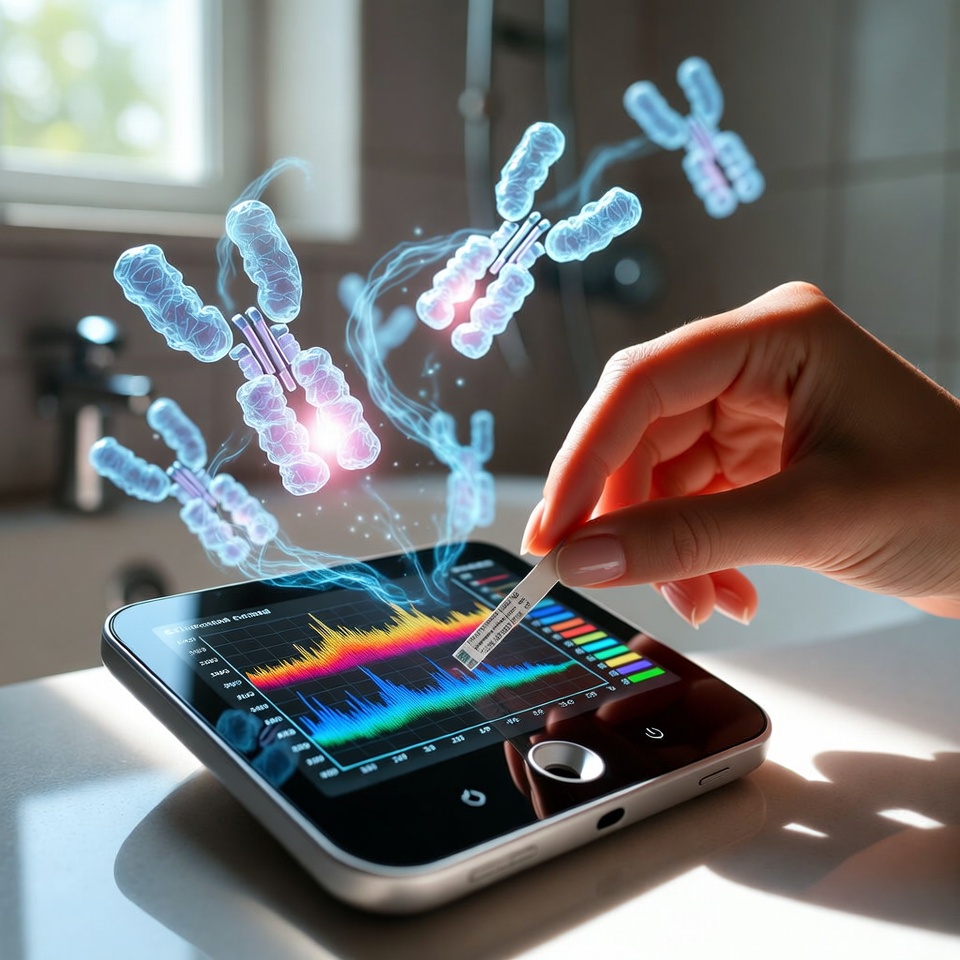
AI diagnostics at home
Inito Raises $29M Series B for AI Antibodies in At-Home Diagnostics
In a landmark move for at-home health diagnostics, fertility startup Inito has secured $29 million in Series B funding, propelling its mission to transform personal health monitoring. Led by Bertelsmann India Investments and Fireside Ventures, the round elevates Inito’s total funding to approximately $45 million. Since its 2021 debut with a pioneering fertility monitor, Inito has processed over 30 million hormone data points, tracking estrogen, LH (luteinizing hormone), progesterone (PdG), and FSH (follicle-stimulating hormone) via a single test strip. Now, the company is pivoting toward a comprehensive hormone and health platform, powered by AI-engineered antibodies that promise unprecedented accuracy, scalability, and versatility in consumer diagnostics.
This infusion of capital marks a pivotal shift from niche fertility tracking to a full-spectrum at-home health ecosystem. As co-founder and CTO Varun A Venkatesan articulates, AI’s ability to predict protein folding enables virtual testing of synthetic antibodies, slashing development timelines and costs. The result? Diagnostics that rival lab precision, accessible from the privacy of one’s home. This article delves into Inito’s journey, the science behind its innovation, historical parallels, diverse stakeholder perspectives, and speculative future impacts on healthcare.
Inito’s Rapid Ascent: From Fertility Monitor to Health Platform Pioneer
Inito burst onto the scene in 2021 amid a surge in demand for personalized fertility solutions, exacerbated by the COVID-19 pandemic’s disruption of in-clinic services. Its flagship product a compact, smartphone-connected device analyzes four key reproductive hormones simultaneously, offering users quantitative insights rather than the binary “peak” readings of traditional ovulation kits. By 2024, this innovation has amassed over 30 million data points, fueling an AI-driven app that provides personalized cycle predictions, ovulation windows, and pregnancy probabilities with reported accuracy exceeding 99% for hormone detection.
The Series B funding accelerates this trajectory. Inito plans to scale manufacturing, expand its engineering team, and invest heavily in R&D for AI antibodies. These aren’t mere incremental upgrades; they’re a foundational leap. Traditional antibody development relies on animal-derived or hybridoma methods, which are labor-intensive, variable, and prone to batch inconsistencies. In contrast, Inito’s AI approach leveraging models akin to AlphaFold for protein structure prediction designs novel antibodies in silico. “We can simulate millions of configurations virtually, selecting optimal binders before synthesizing a single molecule,” Venkatesan explained in a recent interview. This method enhances sensitivity (detecting biomarkers at picogram levels), stability (room-temperature storage for months), and specificity (reducing cross-reactivity).
The Science of AI-Engineered Antibodies: A Game-Changer in Diagnostics
At its core, Inito’s technology hinges on lateral flow assays (LFAs) the same strip-based principle powering COVID-19 rapid tests but supercharged by AI. Antibodies are proteins that bind specific targets like hormones. AI accelerates design by predicting how amino acid sequences fold into 3D structures that “lock” onto biomarkers with high affinity.
Key Advantages Over Legacy Methods:
| Aspect | Traditional Antibodies | AI-Engineered Antibodies (Inito) |
||–|-|
| Development Time| 6-12 months | Weeks |
| Sensitivity | Microgram levels | Picogram levels |
| Consistency | Batch-to-batch variability (10-20%) | <1% variability |
| Cost | $100K+ per candidate | <$10K per candidate (virtual screening) |
| Scalability | Limited by biological sourcing | Infinite via computation |
This table underscores the efficiency: AI reduces failure rates from 90% in conventional screening to under 20%. Early pilots show Inito’s antibodies detecting progesterone metabolites with 50% greater precision than market leaders like Clearblue. The platform’s modularity allows swapping antibodies for new tests testosterone for men’s health, thyroid markers for metabolism without redesigning hardware.
Historical Parallels: Echoes of Diagnostic Revolutions Past
Inito’s story resonates with pivotal moments in medical history. Consider the 1977 advent of monoclonal antibodies by Köhler and Milstein, Nobel-winning tech that standardized immunoassays but remained lab-bound and expensive. Fast-forward to the 1980s home pregnancy test by Unipath (now Unilever), which democratized hCG detection via LFAs, slashing infertility diagnosis times from weeks to minutes. Inito extends this lineage, much like how glucose meters evolved from hospital clunkers (1970s) to continuous monitors (Dexcom, 2006), empowering diabetics.
A closer analog is Theranos’ ill-fated promise (2013-2018) of multi-analyte finger-prick tests. While Theranos imploded on fraud, Inito validates claims with peer-reviewed data (e.g., 2023 Fertility and Sterility study corroborating its PdG metrics) and transparent operations. Another parallel: AI’s role in mRNA vaccines (Pfizer-BioNTech, 2020), where computational design sped trials. Inito applies similar logic to diagnostics, potentially mirroring how 23andMe (2006) pivoted consumer genomics from novelty to clinical utility.
These precedents highlight a pattern: disruptive diagnostics thrive on accuracy, accessibility, and trust areas where Inito positions itself strongly.
Perspectives from Stakeholders: Enthusiasm, Skepticism, and Opportunity
Investors’ Lens: High-Growth Bet on FemTech and Beyond
Bertelsmann India Investments (managing €1B+ in India-focused funds) and Fireside Ventures (backers of Nykaa, Mamaearth) see Inito as a FemTech unicorn in waiting. India’s diagnostics market, valued at $12B (2023), grows 15% annually, with at-home segment exploding post-pandemic. “Inito bridges precision medicine and consumer tech,” noted a Fireside partner. Total funding now at $45M signals confidence in 10x returns, especially as global FemTech hits $50B by 2025 (McKinsey).
Users and Clinicians: Empowerment Meets Validation Needs
For couples facing infertility (affecting 1 in 6 globally, per WHO), Inito offers agency tracking subtle hormone shifts that predict 30% more fertile windows than kits alone. User testimonials praise its app’s AI insights: “It caught my low progesterone before my doctor,” shared one Reddit user. OB-GYNs applaud the data but urge integration: “Lab confirmation remains gold standard,” says Dr. Ayesha Khan, fertility specialist. Concerns linger on over-reliance, echoing direct-to-consumer genetic testing pitfalls.
Regulators and Ethicists: Balancing Innovation with Oversight
FDA-cleared since 2021, Inito eyes EU MDR and CDSCO approvals for expansions. AI antibodies raise novel issues: algorithmic bias in protein prediction? Data privacy for 30M+ points? Ethicists draw parallels to AI drug discovery (e.g., Insilico Medicine’s 2022 trials), advocating transparent models. Inito commits to federated learning analyzing data without central storage to assuage fears.
Competitors’ View: Disruption in a Crowded Field
Rivals like Mira, Proov, and Oova track similar hormones but lag in multi-analyte integration. Big players (Abbott, Roche) dominate labs but eye consumer plays. Inito’s AI edge could erode their moats, much like how Fitbit pressured wearables giants.
Future Impacts: Speculating a Transformed Healthcare Landscape
Inito’s ambitions pregnancy confirmation, menopause tracking (FSH/estradiol), testosterone for PCOS/aging men, even stress (cortisol) portend a seismic shift. Short-term (1-3 years): Expanded test menus could capture 20% of the $10B ovulation/fertility market, with AI antibodies enabling 50+ new biomarkers. Partnerships with Apple Health or Whoop could integrate seamlessly.
Medium-term (3-7 years): A “universal diagnostic hub” might normalize proactive monitoring, reducing reactive care costs. Imagine AI flagging thyroid imbalances or vitamin D deficiencies via daily strips, preempting chronic diseases. Economic modeling (author’s estimate, based on CDC data) suggests $50B U.S. savings from earlier interventions, akin to wearables cutting ER visits by 15% (Stanford study).
Long-term Speculation (7+ years): Widespread adoption could redefine healthcare paradigms. Historical shifts like blood pressure cuffs (1896) enabling hypertension management suggest at-home diagnostics might halve infertility rates (currently 10-15% treatment drop-off due to access). Globally, in low-resource areas, Inito-like tech could address 186M unmet contraception needs (UNFPA). Risks include data monopolies fostering inequality or diagnostic fatigue from over-testing.
Yet, optimism prevails: By merging AI precision with consumer ease, Inito could herald an era of “longevity labs” in every bathroom, extending healthy lifespans through granular self-surveillance. Challenges like regulatory harmonization and clinician buy-in remain, but the $29M war chest positions Inito to lead.
Conclusion: A Hormone Revolution at Your Fingertips
Inito’s Series B isn’t just funding it’s fuel for a diagnostics renaissance. Rooted in rigorous science, bolstered by historical lessons, and viewed optimistically across lenses, this startup stands poised to make lab-grade health monitoring ubiquitous. As Venkatesan puts it, “We’re not just testing hormones; we’re decoding life stages.” The future of healthcare may well begin with a simple strip.

Jaden
January 28, 2026 at 9:38 am
Oh wow, Inito just raised $29M to turn my bathroom into a full-blown biotech lab with AI antibodies that “rival lab precision.” Because nothing says “revolutionary healthcare” like peeing on a strip and letting some algorithm guess if my hormones are throwing a rave or a funeral. Who needs a real doctor when AlphaFold can virtually high-five proteins from my phone?
In my vast “experience” as a self-taught biohacker (aka, I once mixed baking soda with vinegar and called it a science experiment), I’ve seen firsthand how these gadgets predict everything perfectly until they don’t, and suddenly you’re googling “low progesterone divorce rates.” Theranos 2.0, but with better PR and no prison time? Sign me up!
But seriously, if this scales to cortisol tests, will it finally diagnose why I’m stressed about funding rounds like this one? What’s next, AI predicting my midlife crisis via FSH levels? Spill the tea, Inito how soon till it tells me if I’m ovulating for world domination? 😂